I have become an occasional blogger for PROSPECT MAGAZINE. My first contribution is now live. It is a slightly edited version of the following:
My old friend Professor Stanley Wells was on the 10 o’clock News last night, raining on the RSC’s parade as they showed off their new theatre to the world’s press. Full disclosure: I am on the Board of the RSC. But what’s the argument about here?
Shakespeare wrote for a bare platform stage thrust into the auditorium, with the audience gathered around it. The “open yard” playhouses of his world were torn down when the Puritans closed down the theatres in the 1640s. When the theatrical profession resumed with the Restoration of the monarchy in 1660, new indoor playhouses were built and the proscenium arch was introduced, creating a picture-frame stage. All through the eighteenth and nineteenth centuries, theatre was effectively experienced in a two room environment: the world of the play was separated from the auditorium by the proscenium. The division was heightened when Wagner introduced the innovation of a darkened auditorium.
When Elizabeth Scott designed the Royal Shakespeare Theatre in the 1930s, she had a track record of creating cinemas. And the old RST auditorium did indeed resemble a cinema. The cinema took the two room idea to an extreme: the movie would be exactly the same whether the auditorium was full, half full or empty. That’s not something that can ever be said of a play performance in the theatre. The old RST was in thrall to the new art of film. But times have changed.
The need not to imitate the cinema seemed to me the overriding demand for a redesign of the theatre. That is to say, the movies, television and related digital/virtual media now create realistic alternative worlds so fully and powerfully that live theatre cannot compete with them. Soon, it will be routine for us to enter those alternative virtual worlds in three dimensions. What then is left for theatre to do?
There is no better answer than to say: return the Shakespearean theatre to its origins. Go live, create a shared experience in which audience and play-world are together in one room, looking at each other, interacting. Not sitting in the darkness as passive spectators of an alternative world. What is more, a thrust stage is amenable to what the great Peter Brook called rough theatre. By doing away with the elaborate, “realistic” stage sets of the eighteenth and nineteenth century, theatre we can focus on the simple transformative magic of playing. Falstaff: “This chair shall be my state, this dagger my sceptre, and this cushion my crown.”
Where I have some reservations with regard to both the reconstructed Globe on Bankside and the new RST is with regard to the depth of the thrust. The further the platform extends into the auditorium, the more problems you have with sightlines and the more it becomes necessary for actors to keep moving: as Peter Hall has said with regard to the RST’s smaller auditorium, The Swan, built on the same principles, it’s a great theatre on which to make a striking entrance downstage (who can forget Antony Sher bestriding that small space as Marlowe’s colossal Tamburlaine?), but once you’re there you have to find a way to go back. Shakespeare learnt his trade not at the Globe, but at Philip Henslowe’s Rose Theatre, which, as archaeological excavations in the 1990s revealed, had a wide, shallow stage. Imagine a lozenge. Sightlines are better in a space of that kind, and there are intriguing possibilities for lateral staging, for example involving paired tableaux that create a kind of split screen effect. Shakespeare’s Rose plays have many strong examples of one group of characters entering at one door, a rival group entering at the door on the other side of the stage.
One of the key differences in design between the new RST and the temporary Courtyard Theatre, further up Stratford’s Waterside, which has been the RSC’s (highly successful) temporary home during the redevelopment, and its prototype for the new theatre, is that the new auditorium has the capacity to be adapted to a wider and shallower stage. It can be a modern Rose as well as a modern Globe. And, as a matter of fact, the thrust can be taken out altogether, just in case one day theatre reinvents itself again in proscenium form. Somehow, though, I don’t think that’s going to happen.
Wednesday, 24 November 2010

Friday, 22 October 2010
The Female Repertoire
Further to my suggestion in English Literature: A Very Short Introduction that 'repertoire' is a more valuable term than 'canon', I have been asked to reflect on whether or not the shift of terminology has any bearing on the debate about the gendering of the canon. For a generation, feminists have been arguing that the canon as traditionally received is predominantly male. 'Canon' is a term that comes from Biblical criticism. It might be said that, just as the books of the Bible are predominantly male-voiced, with a few exceptions such as the Books of Ruth and Esther, so the canon is predominantly male, with a few exceptions such as Jane Austen, George Eliot and the Brontes. What is more, Eliot and the Brontes wrote under male pseudonyms and Austen published anonymously. The assault on the canon is associated with the term "dead white European males." In my Guardian column linking the VSI to Michael Gove's remarks about the teaching of classic literary texts in schools, I defended the value of the dead and suggested that the literary repertoire of these islands has always been ethnically highly diverse, as witnessed by the fact that the earliest identifiable author in the tradition could variously be argued to be a Celt (Ossian), a Roman (Julius Caesar) or an Anglo-Saxon (Caedmon). This provoked the response: if these are the fathers of English Literature, who is the mother?
The answer that the book offers to this question is: a variety of female religious writers from the post-1066 era, for example the author of the 13th century Ancrene Wisse. I am not aware of any identifiable pre-1066 female authors, but I'd love to hear about them. The book also proposes that the study of English Literature has been in some sense limited by our tendency to think only about literature in the English language. Thus it suggests that the honour of being the first English poet to have their works collected in a quasi-scholarly edition, with commentary, in the manner of editions of the classics of ancient Greek and Rome, belongs to a woman, Elizabeth Jane Weston, but that she has been neglected not because she was a woman but because she wrote in Latin and lived for much of her life in Prague.
I introduce the term "repertoire" by analogy with the theatrical repertoire, which is something much more fluid than a "canon." One of the things that struck me in doing the research for the book was how the eighteenth-century repertoire gave much more space to women dramatists than the nineteenth: I'd like to know more about exactly when and why those fine dramatists Susanna Centlivre and Hannah Cowley dropped out of the repertoire.
The answer that the book offers to this question is: a variety of female religious writers from the post-1066 era, for example the author of the 13th century Ancrene Wisse. I am not aware of any identifiable pre-1066 female authors, but I'd love to hear about them. The book also proposes that the study of English Literature has been in some sense limited by our tendency to think only about literature in the English language. Thus it suggests that the honour of being the first English poet to have their works collected in a quasi-scholarly edition, with commentary, in the manner of editions of the classics of ancient Greek and Rome, belongs to a woman, Elizabeth Jane Weston, but that she has been neglected not because she was a woman but because she wrote in Latin and lived for much of her life in Prague.
I introduce the term "repertoire" by analogy with the theatrical repertoire, which is something much more fluid than a "canon." One of the things that struck me in doing the research for the book was how the eighteenth-century repertoire gave much more space to women dramatists than the nineteenth: I'd like to know more about exactly when and why those fine dramatists Susanna Centlivre and Hannah Cowley dropped out of the repertoire.
Wednesday, 6 October 2010
Very Short English Literature
Fitting that my Very Short Introduction to English Literature is published on the day that Michael Gove tells the Tory party conference that we need a return to the canon -- to Pope, Dryden, Keats and Shelley. I argue in the book that "repertoire" is a better term than "canon", but I'm hoping for lively debate on the subject.
Meanwhile, I have blogged for the publisher, OUP, on the subject of the book, so I won't do so here, but will merely provide a link.
Meanwhile, I have blogged for the publisher, OUP, on the subject of the book, so I won't do so here, but will merely provide a link.
Thursday, 23 September 2010
One Man and his Dog

One more photo from The Man from Stratford in action. Simon Callow shares his stage with just one other creature ...
Tuesday, 21 September 2010
Shakespeare on TV
The Telegraph asked me to write a Comment about the news that the BBC plans to show 6 Shakespeare plays, including one live performance, as part of the Shakespeare Festival that will be the centre of the 2012 Cultural Olympiad. I've always had my doubts about Shakespeare on TV - preferring it on radio in lots of ways - and I don't have good memories of the 1970s BBC versions. The National Theatre broadcast-to-cinema experiment has been fantastic, but the point I make in the Comment is that a cinema audience is a community, a group with a sense of occasion, whereas a television audience is fragmented and distracted. But let's live in hope.
Wednesday, 8 September 2010
The Man From


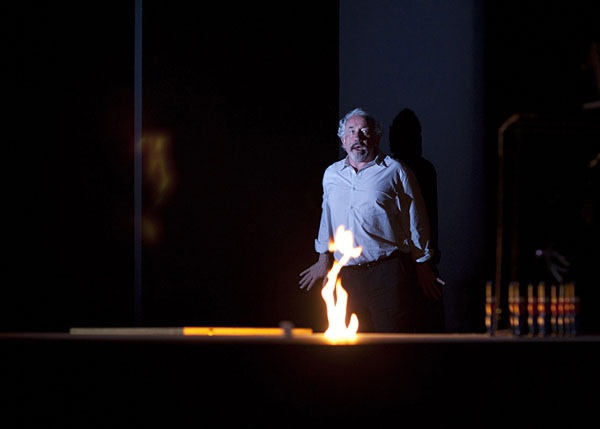
This blog has been silent through a hectic summer, much of it spent following The Man from Stratford around the country. So here are some pix of The Man in action.
Saturday, 29 May 2010
Henry IV Parts 1 & 2
The line of thinking that I was beginning to sketch out in my last blog entry has now been developed at greater length for a piece published in today's Guardian: Shakespeare's Best History Plays.
Subscribe to:
Comments (Atom)


