Wednesday, 8 September 2010

The Man From


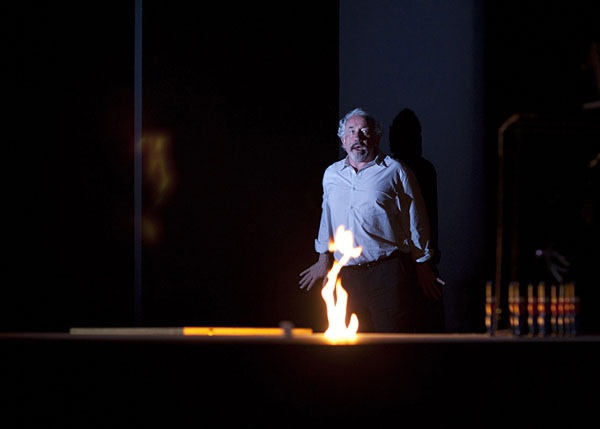
This blog has been silent through a hectic summer, much of it spent following The Man from Stratford around the country. So here are some pix of The Man in action.

Saturday, 29 May 2010

Henry IV Parts 1 & 2

The line of thinking that I was beginning to sketch out in my last blog entry has now been developed at greater length for a piece published in today's Guardian: Shakespeare's Best History Plays.

Monday, 26 April 2010

Shakespeare and the Privatized Military


Shakespeare has a long history of refreshing the parts of life that other writers have difficulty in reaching. One of the more surprising lecture invitations I have received was to talk to a conference of the “family offices” of “high net worth individuals.” Hard as I found it to imagine what it would be like to be so rich that you needed advisers to help you keep your family in order, I went along and it proved a fascinating occasion. The brief was to explore how Shakespeare dealt with the problem of succession. I took the examples of Prince Hal as rebellious son who goes slumming it in Eastcheap (or, as it would now be, snorts lines of cocaine at Boujis) and of King Lear’s difficulties over the division of his kingdom among his three children. Afterwards, several people—both advisers and family members—told me that I had precisely described their experience.
I was reminded of this sense that Shakespeare has something to say to worlds far from the theatre and the library when this morning I happened upon an article about Falstaff in the most unlikely place: the Journal of International Peace Operations. This is not, as the title might suggest, the august organ of a think tank for NGOs in the aid trade, but rather the house magazine of the International Peace Operations Association, the trade association of the burgeoning private military industry—though they do not call themselves "private armies," but rather "the Stability Operations Industry." It is reassuring to note that Blackwater Worldwide (now renamed Xe Services, following all its bad publicity in Iraq) was expelled form the association in 2007.
Anyway, here is the article in question: “Shakespeare on Military Contracting: Lessons from History about Private Contracting.” The piece proves to be extremely well informed not only about the tricky issue of the resemblances/differences between Falstaff in Henry IV and Sir John Fastolf in Henry VI, but also with regard to the finances of raising an army in the early modern period when there was no state standing army. I don’t know of any better introduction to the fascinating question of Falstaff’s role as a military entrepreneur.
I’m not sure that the author, Gary Sturgess, draws quite the right conclusion from the plays: “He may be a figure of fun, but Falstaff shows us that incentives matter.” A better conclusion might have been “state provision is usually burdened by inefficiency, but reliance on the private sector is usually tarnished by corruption and inevitably leads to the exploitation of the poor.” Still, at a time when all political parties are asking what are the services that must be provided by the state and what are those that can be contracted out in the name of “efficiency savings”, there is grist in the “lesson from history” that a state-run as opposed to a entrepreneurially-led army is a relatively new phenomenon in Britain.
My thanks to the polemical new journal Cambridge Literary Review for drawing my attention to the piece.

Sunday, 25 April 2010

Amazon Reviews, Uxoriousness and Sock Puppetry

One of the pleasures of being married to another writer is the discovery that two people can do the same sort of thing—researching, writing, publishing—in such different ways. I can only write at the last minute before a deadline, whereas Paula gets herself organized way in advance. I get very insecure about published reviews but ignore readers’ reviews on Amazon, whereas Paula refuses to read her reviews in the press but pays a lot of attention to what she calls “real readers’ reviews” on Amazon. I suppose the difference there is that as a professor I worry about reputation and the “peer-review” process of published reviews, while as a full-time author Paula cares most about giving pleasure to her readers. To judge from the glowing reviews of her Mad World on Amazon, almost all of which have “real names”, anonymous reviewing is going out of fashion there—except, of course, in the much-discussed case of Professor Orlando Figes (who seemed to me a perfectly good bloke when I met him at a dinner party when we were graduate students aeons ago, and whose Natasha’s Dance was, I thought, a very enjoyable and informative survey of Russian culture). As everyone knows, first he denied any involvement in the anonymous Amazon reviews knifing his rivals’ books and praising his own to the skies, then he announced that his wife had written them.
At this point, I felt like raising a cheer for Mrs Figes. Uxoriousness (maritoriousness?) seems to me an excusable, even a desirable, vice. Indeed, I committed a gross act of it myself last summer when Mad World was published. One particular review claimed that it covered the identical territory to another, previously published book: knowing how extensively Paula had sweated over primary sources, how much new material she had unearthed and how utterly different it was from the other book, I wrote an irked email to the reviewer and editor in question, chiding them for this blatant untruth … which elicited a charmingly apologetic reply that quite disarmed me and made me very glad that I had not embarrassed myself by throwing my husbandly hissy fit in public.
Now it is revealed that it wasn’t Mrs Figes in the library with the pen poisoned by uxoriousness, but actually Professor Orlando in the chatroom with the sock puppet. For me, the discovery of the splendid term sock puppetry has been the real revelation of the affair. Here is a link to an article about how a couple of years ago the prof appears to have used some other sock puppets to tart up his own Wikipedia entry.
On a more serious note, though, the attempt to use threatening letters from lawyers to silence fair literary comment, as described in the TLS’s powerful account of its own role in the affair, is chilling in itself and utterly bizarre, in a very Freudian way, coming from someone whose most recent book concerns the whisperings of the Stalinist secret police and their informers.

Saturday, 10 April 2010

In our Time: Hazlitt

The In Our Time discussion of Hazlitt should be on the iplayer for a while. I'd have liked it if we'd had more time to talk about his portrait painting and the continuity with his writing - perhaps his best book is The Spirit of the Age, which is a series of pen-portraits of the great minds of his time, a writerly equivalent of portraiture.

Tuesday, 23 February 2010

Leader with a Temper

Some things don't change. Leaders do not like being told bad news and can lose their temper with the messenger. Shakespeare, inevitably, catches this impeccably:

MESSENGER Madam, he’s married to Octavia.
CLEOPATRA The most infectious pestilence upon thee!
Strikes him down
MESSENGER Good madam, patience.
CLEOPATRA What say you?
Strikes him
Hence, horrible villain, or I’ll spurn thine eyes
Like balls before me! I’ll unhair thy head!
She hauls him up and down
Thou shalt be whipped with wire and stewed in brine,
Smarting in ling’ring pickle!
MESSENGER Gracious madam,
I that do bring the news made not the match.
CLEOPATRA Say ’tis not so, a province I will give thee,
And make thy fortunes proud: the blow thou hadst
Shall make thy peace for moving me to rage,
And I will boot thee with what gift beside
Thy modesty can beg.
MESSENGER He’s married, madam.
CLEOPATRA Rogue, thou hast lived too long! Draws a knife
MESSENGER Nay then, I’ll run.
What mean you, madam? I have made no fault. Exit
CHARMIAN Good madam, keep yourself within yourself.
The man is innocent.
CLEOPATRA Some innocents scape not the thunderbolt.

Great stage direction, that: she hauls him up and down.

Monday, 11 January 2010

On Delivering


Probably the most satisfying moment for an author - more than seeing the work set in print when the proof comes or even when receiving the first copy - is that of delivery. Hitting the send button. Especially as the final stages of writing - cutting to length, removing repetition, checking references - are so laborious. Ecstasy therefore this morning as my English Literature: A Very Short Introduction wings its way through the ether to Oxford University Press.

Early research for the book was done over a year ago (mentioned in my Writer's Rooms feature in The Guardian), but the writing has been rapid fire in the last few months, including a blissful escape to France alone for a few days, and then, for the final push, taking advantage of the village being snowed in.

An especially satisfying book to write because short! A ludicrous proposition to introduce a subject the size of EngLit in 50,000 words (I pushed them up from the standard 40k for the series by cunningly asking for 60k and splitting the difference...). But the series guidelines are very helpful: "The text should not read like an encyclopedia entry or a textbook; depending on the topic, it may be more comprehensive or more idiosyncratic in its coverage. Don't be afraid to express a point of view or to inject some style into the prose. Focus on issues, details, and context that make the subject interesting; you should draw your reader in with examples and quotations. Give the reader a sense both of your subject's contours and of the debates that shape it." Good principles, which have made for a great series - so many people have said how much they like these little books.

No one will expect 'coverage' from such a thing, but there are bound to be some reviews and reader responses along the lines of "I can't believe that X didn't get a single mention." Among the initial candidates for X are: medieval mystery plays, the Brownings and the Rossettis, H. G. Wells. Over the coming months before publication - scheduled for October - I will try to list as many as I can of my apologies to the shades of the mighty dead whom I have neglected. As far as the living are concerned, I've been very selective. They can look after themselves.

A living author I greatly admire is Richard Powers. I review his latest novel, Generosity, in the latest TLS, but it doesn't have a free access online link to the piece. So instead, here is a picture of the village - well at least the church, which I look out on from my study - covered in snow.